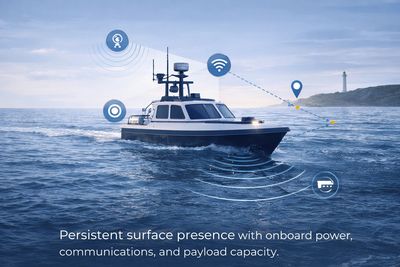
PERSISTENT SURFACE PLATFORM (USV)
The USV is the operational backbone—delivering endurance, mobility, and connectivity.
The surface platform acts as a stable and persistent base for missions in coastal, inland waterway, port, and flood environments. It can remain on station for extended periods while carrying sensors, payloads, and supporting connected aerial or subsurface assets.
Designed for practical deployment, the platform combines autonomous navigation with human-supervised control. It can serve as a communications relay, mobile sensor hub, and launch platform while reducing the need to expose crews to hazardous conditions.
Compared with crewed vessels or short-endurance drones, the USV enables longer-duration operations at lower operating cost, making it suitable for public safety, monitoring, inspection, and security applications.
Tethered UAV
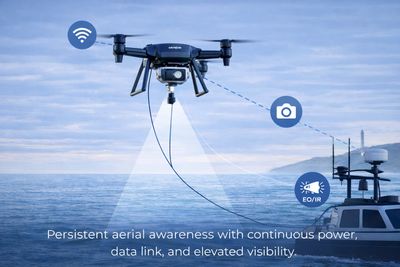
Persistent aerial awareness with continuous power, data link, and elevated visibility.
The tethered UAV provides an elevated sensor position above the operational area while receiving continuous power and secure data connectivity from the surface platform.
Unlike battery-limited drones, the system can remain airborne for extended periods, supporting EO/IR observation, spotlighting, communications relay, and wide-area monitoring.
Because the aircraft remains linked to the host platform, it offers a practical and controlled route to persistent aerial capability in coastal, port, flood, and emergency environments.
SUBSURFACE SENSING
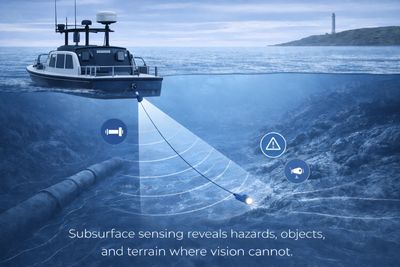
Subsurface sensing reveals hazards, objects, and terrain where vision cannot.
The system uses sonar-based sensing to build awareness below the surface where cameras and human observers are limited.
Depending on mission needs, this can support object localization, shallow-water mapping, obstacle detection, infrastructure inspection, and search operations in turbid or low-visibility conditions.
When combined with surface and aerial data, subsurface sensing contributes to a more complete operational picture for coastal, port, inland waterway, and emergency environments.
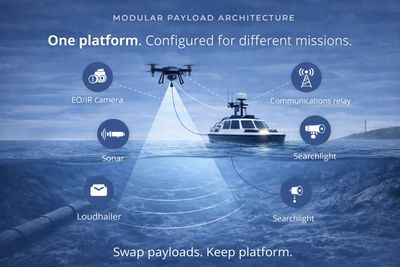
Modular Payload Architecture
One platform. Configured for different missions.
The platform is designed around a modular architecture that allows sensors, communications equipment, and mission tools to be configured to operational needs without changing the core vehicle system.
This enables rapid adaptation between coastal response, inspection, flood operations, monitoring, and security tasks while reducing integration complexity and cost.
As requirements evolve, new payloads can be added over time—protecting investment and extending platform relevance.
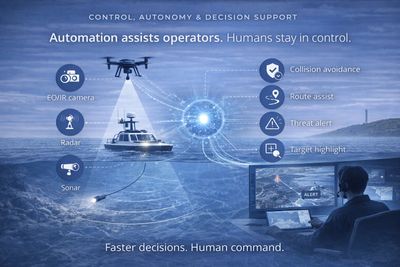
CONTROL, AUTONOMY & DECISION SUPPORT
Automation assists operators. Humans stay in control.
The system uses onboard automation and pattern-recognition tools to reduce operator workload, improve situational awareness, and highlight relevant information during time-critical missions.
Typical support functions may include navigation assistance, collision avoidance, sensor management, anomaly alerts, and multi-sensor correlation across air, surface, and subsurface data.
Decision authority remains with the human operator at all times. Automation is applied to support judgement—not replace it.
SAFETY, RELIABILITY & REGULATORY ALIGNMENT
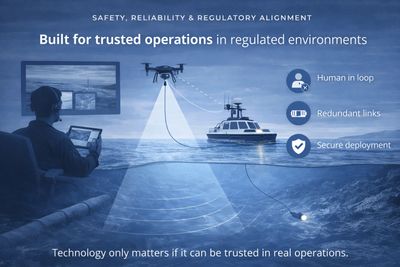
Built for trusted operations in regulated environments
deJongSmit’s system philosophy starts with operational trust. Redundancy, fail-safe behaviors, secure communications, and predictable degradation modes are designed into the architecture from the outset.
Rather than pursuing autonomy for its own sake, the system keeps humans in control while automation reduces workload, improves awareness, and supports faster decisions.
The platform is intended to align with applicable maritime, aviation, and public-safety operating frameworks, enabling realistic deployment pathways with institutional partners.
Technology only matters if it can be trusted in real operations.